Pharath Sathya
Lead ML Engineer · Kyoto University IST · Kurohashi Lab
About
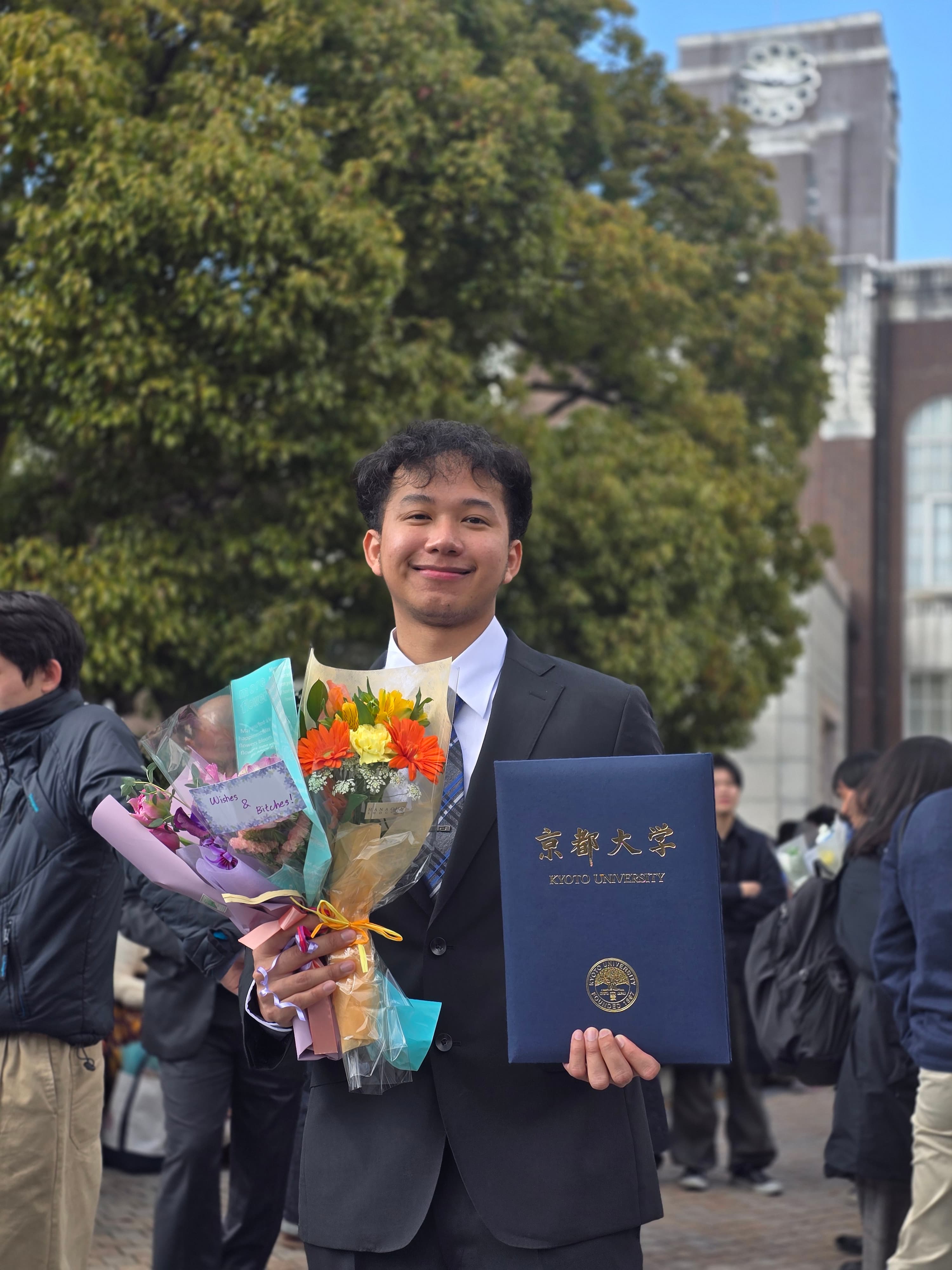
Senior-year Electrical & Electronics Engineering student at Kyoto University, operating at the intersection of Signal Processing, Embedded Systems, and AI. In April 2026, I begin my M.S. at Kyoto University continuing research at the Language Media Processing Lab (Kurohashi Lab).
My research focuses on multi-agent AI systems and collective intelligence in creative problem-solving. My current work evaluates AI creativity in storytelling — and I want to extend it to audio, image, and video. When LM-as-judge experiments diverge completely from human ground truth, that's not a failure to me. That's a gold mine.
Beyond academia, I'm Lead ML Engineer at Senren, Inc., architecting automation logic for production NLP services. Previously I designed precision timing circuits for Quantum Sensing at the University of Tsukuba. I like sitting where hardware meets software — understanding both sides is an unfair advantage.
skills
Experience
Apr 2026 – Mar 2028
M.S. in Informatics (Intelligence Science and Technology)
Kyoto University — Kurohashi Lab
Research focus: NLP, LLM Alignment with Human Creativity, LLM-as-a-Judge, Multimodal Foundation Models, Multi-Agent Systems, and Low-Resource Language Processing (Khmer).
Aug 2025 – Present
Lead AI Engineer
Senren, Inc.
Architecting prompt optimization with DSPy, leading experimental-to-production NLP transitions. Own model selection decisions and cross-stack integration.
Nov 2025 – Present
AI Research Engineer
KyotoAI (Government Subsidized Startup)
Training custom reward models with RL, optimizing RMSearch for retrieval. Built LLM coding benchmarking suite against BigCodeBench for B2B enterprise deployments.
Apr 2025 – Mar 2026
Undergraduate Researcher — LLM Alignment & Evaluation
Kyoto University — Kurohashi Lab
Authored preprint on AI Creativity Evaluation (arXiv:2601.03698), presented at NLP2026. Benchmarked SOTA open-weight and proprietary models on reasoning and alignment.
Apr 2022 – Mar 2026
B.S. in Electrical and Electronics Engineering
Kyoto University
Graduation thesis: Evaluation of Large Language Models on Human Creativity Alignment. Signal processing, embedded systems, and AI.
Aug 2024
Hardware Research Engineer (Quantum Sensing)
University of Tsukuba
Designed digital pulse generation circuits and calibrated precision measurement setups for quantum sensing applications.
Apr 2023 – Present
Trilingual Technical Interpreter
Hanamizuki Co. Ltd
Japanese ↔ English ↔ Khmer. Official interpreter for the Prime Minister of Cambodia's security detail during state visits.
Projects
End-to-end reinforcement learning pipeline for training custom reward models, with a comprehensive benchmarking suite evaluating LLM coding performance against BigCodeBench standards.
Production prompt optimization system at Senren using DSPy for programmatic prompt engineering. Enforces strict JSON schemas for structured data extraction across NLP services.
Human-grounded framework for evaluating creativity in AI-generated stories. Decomposes creative quality into 4 dimensions and 11 sub-components, validated through crowdsourced evaluation with 115 participants.
Research
Evaluation Framework for AI Creativity: A Case Study Based on Story Generation
NLP2026 (NLP Society of Japan) · 2026
We propose an evaluation framework addressing challenges in assessing creative text generation. The framework includes four main dimensions — Novelty, Value, Adherence, and Resonance — and eleven sub-components. Through controlled story generation using Spike Prompting and a crowdsourced evaluation involving 115 readers, we find that creativity is evaluated hierarchically rather than cumulatively, with different dimensions becoming salient at different stages of judgment. Reflective evaluation substantially shifts both ratings and inter-rater agreement, demonstrating the framework's capacity to expose creativity dimensions that conventional reference-based metrics overlook.
Pharath Sathya, Yin Jou Huang, Fei Cheng
Creativity Is Not Enjoyment: Rethinking Human Evaluation of AI Story Generation
ANLP (Advanced NLP) · 2026
Large language models are often optimized to generate creative text, yet it remains unclear whether creativity translates to user satisfaction. We propose a framework that evaluates creativity and enjoyment as separate dimensions. Through a controlled study with diverse AI-generated stories, we show that creativity judgments rely primarily on novelty, whereas enjoyment depends on emotional resonance. Optimizing for novelty alone increases perceived creativity but can reduce user satisfaction, revealing a fundamental trade-off in current generation methods.
Pharath Sathya, Yin Jou Huang, Fei Cheng
References
“[Placeholder — add real quote]”
[Name]
[Title / Organization]
Research supervisor
“[Placeholder — add real quote]”
[Name]
[Title / Organization]
Engineering colleague
“[Placeholder — add real quote]”
[Name]
[Title / Organization]
Collaborator
Get in touch
Open to research collaborations, full-time roles, and anything at the edge of what current AI can actually do. Starting M.S. at Kyoto University in April 2026.